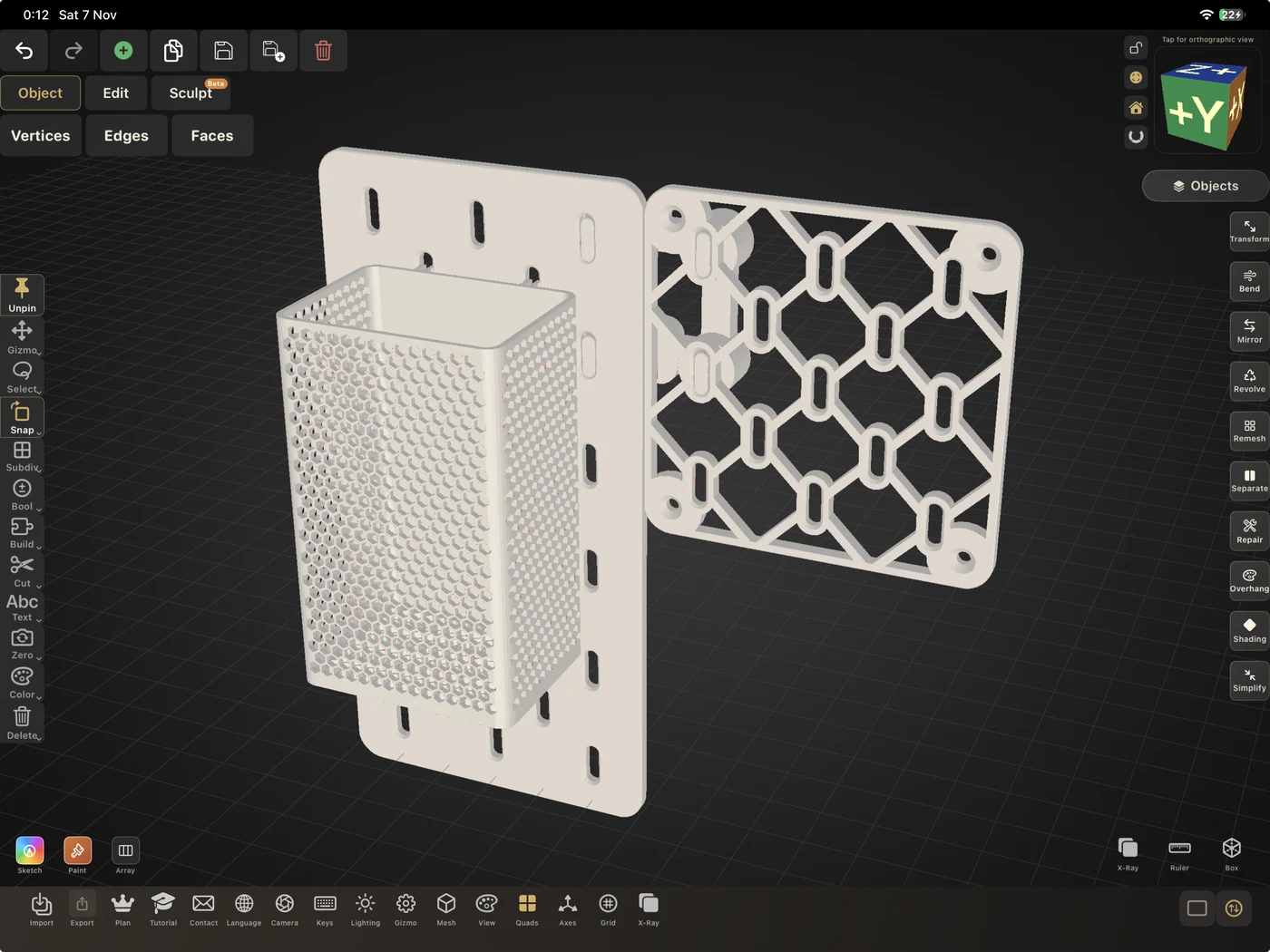
Design a custom pegboard wall on iPhone or iPad: parametric boards with SKÅDIS-compatible 5×15 mm slots, standoff and clip connectors, and storage bins — exported as STL or 3MF, ready to slice. No CAD experience needed.
Updated November 7, 2026 · Published by Forma3D
Open the Add panel and choose Pegboard. Boards use the SKÅDIS-compatible slot pattern: 5×15 mm stadium slots on a 40 mm pitch. Pick a size preset or switch to Custom and type the exact width and height in millimeters — the slot grid scales to fit.
Solid is a flat panel for maximum strength; Lightened carves a truss pattern between slots and saves 30–50% filament on large panels. For edges, Margins adds a clean frame around the slot field, while Seamless runs the slot pitch to the edges so several printed tiles line up into one big wall.
Pick how the board meets the wall. Countersunk bores 45° countersinks flush with the face for flat-head screws. Combined with standoff connectors (next step) you get the floating gap that lets accessories hook behind the board.
Add a Pegboard Connector primitive. Standoff mounts hold one, two or four boards and come in three fixings: an M3/M4/M5 screw with matching nut, a self-tapping screw into the post, or adhesive tape. Slot clips carry ribbed stadium pegs that press into the 5×15 slots for screw-free mounting — their clearance parameter tunes the fit to your printer.
The Pegboard Bin primitive builds a parametric storage box: set width × depth × height in millimeters, then choose how many peg columns and levels it carries on the back. Like the boards, bins come in Solid or Lightened styles — the lattice walls on the lightened bin print fast and let you see what's inside.
Export each piece as STL, or 3MF to keep face colors for multi-material slicers. Print boards flat on the bed, connectors upright, and bins open-side up. Because every dimension is parametric, you can remix the same parts at other sizes without re-modeling.
These primitives are real meshes, not locked presets — drop one into Edit mode to cut a logo into the board, Boolean a hook shape onto a bin, or merge a connector into a custom bracket. The same Add panel also makes boxes, text and organizer parts that can share the slot geometry.
See STL mesh editing for modifications, splitting large models if a board exceeds your bed, and printing without a desktop for the phone-to-printer pipeline.
The generator uses the same 5×15 mm stadium slots on a 40 mm pitch as the IKEA SKÅDIS system, so SKÅDIS-style hooks, clips and accessories are designed to fit. Always test-fit one slot with a small print first — printer tolerances vary.
Yes. Use the Seamless edge mode to tile slot pitch across several boards, print them as separate tiles and join them on the wall with connector plates. The slots line up across tile boundaries because the pitch is parametric.
Bins carry ribbed stadium pegs on a configurable column-by-level grid that press into the 5×15 slots. The pegs are slightly undersize with raised ribs for a friction fit, and a clearance parameter lets you tune the fit to your printer.
PETG or PLA both work; PETG tolerates peg flexing better for removable accessories. Print boards flat, use 3+ walls on connectors and bins, and pick the Lightened style to save filament on large panels.
Available on iPhone and iPad